





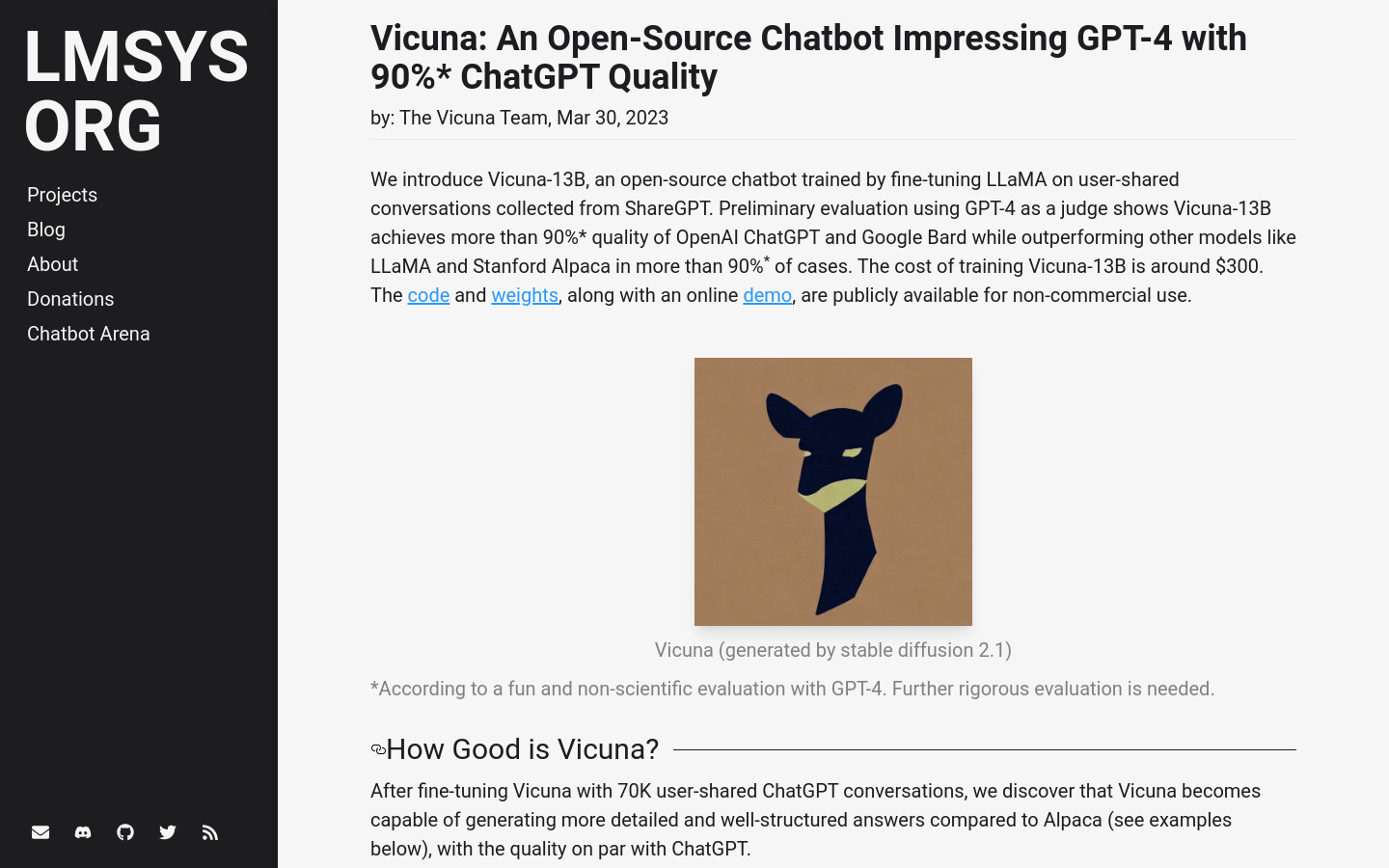
Vicuna
Vicuna:The Open-Source Chat Robot (Like ChatGPT)
Tags:AI chatbotAI chatbot AI model Alpaca Chatbot ChatGPT LLaMA Open Source Paid Standard PicksVicuna: An Open-Source Chatbot Model
Overview
The Vicuna chatbot is an open-source AI model developed through fine-tuning of the LLaMA algorithm using user-shared conversation data. It has demonstrated remarkable performance in various conversational tasks, achieving 90% of the quality benchmarks set by industry leaders like OpenAI ChatGPT and Google Bard across over 90% of test cases. Independent evaluations using GPT-4 as a scoring system also revealed that Vicuna outperformed other leading models such as LLaMA and Stanford Alpaca in more than 90% of scenarios. The development cost for the Vicuna-13B version is estimated to be approximately $300, making it an affordable option for developers.
The project provides comprehensive resources including:
- Complete source code
- Trained model weights
- An online demo environment
All these are available for non-commercial use under open-source licensing terms.
Target Audience and Use Cases
Who Should Consider Using Vicuna?
Vicuna is designed to serve as a versatile foundation for building custom chatbots. It is particularly suitable for:
- Developers: Building customized chatbot solutions for specific applications.
- Researchers: Experimenting with AI-driven conversational interfaces.
- Enterprises: Integrating advanced chat capabilities into existing systems.
Key Features and Capabilities
Advanced Response Generation
Vicuna excels in producing detailed, structured, and contextually relevant responses. This makes it particularly effective for complex conversational scenarios where nuanced understanding is crucial.
Performance Parity with Leading Models
Through rigorous testing, Vicuna has shown that its output quality is on par with the highest levels of performance demonstrated by major players in the AI chatbot space.
Open Source Accessibility
Vicuna’s codebase and model weights are publicly available, enabling developers to:
- Deploy the model as-is
- Customize it for specific use cases
- Further train it using additional datasets
This open-source approach fosters innovation and collaboration within the AI community while maintaining a strong focus on ethical usage through its non-commercial license terms.


